
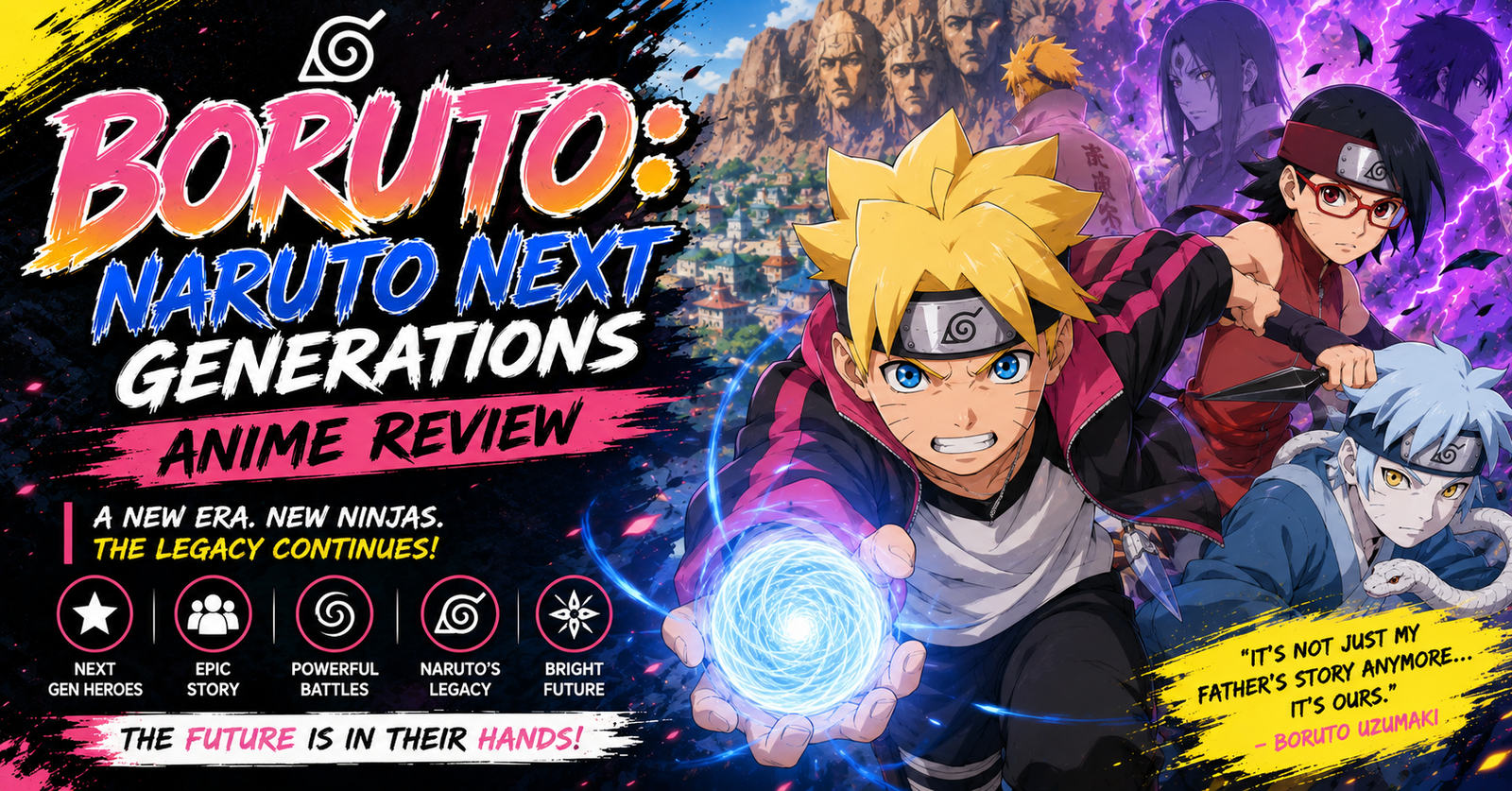

Boruto: Naruto Next Generations had a tough job from the start: follow up one of the most beloved shonen franchises ever made, using a new lead who spends a chunk of the story rejecting the very ideals his father built a legacy on. This review breaks down the story, the creative team behind it, the voice performances, and the score, along with an honest look at where the series succeeds and where it stumbles.
What Is Boruto: Naruto Next Generations About?
Set years after the events of Naruto: Shippuden, the series follows Boruto Uzumaki, son of the now-Hokage Naruto, as he trains to become a ninja alongside teammates Sarada Uchiha and Mitsuki. Unlike his father, Boruto grows up resentful of a dad who’s constantly absorbed in village duties, and that tension fuels a lot of his early character arc. Based on Masashi Kishimoto’s original Naruto manga and its spin-off material, the show gradually widens its scope to cover new threats, including the mysterious Kara organization, while touching on legacy characters from the original cast in supporting roles.
The Creative Team Behind Boruto
The series was co-directed by Noriyuki Abe and Hiroyuki Yamashita, with series composition handled by Makoto Uezu and production once again coming from Studio Pierrot. Character designs were handled by Tetsuya Nishio and Hirofumi Suzuki, both of whom carried over a visual style that feels connected to the original series while giving the new generation a distinct look. Story supervision came from Ukyo Kodachi, who co-created the Boruto manga with illustrator Mikio Ikemoto, giving the anime a tighter connection to its source material than some earlier filler-heavy stretches of the franchise.
Voice Cast: New Faces, Familiar Names
The Japanese cast introduces Yuko Sanpei as Boruto, Kokoro Kikuchi as Sarada, and Ryuichi Kijima as Mitsuki, three performances that had to establish new dynamics without leaning entirely on nostalgia. Naruto himself is still voiced by Junko Takeuchi, now performing an older, more world-weary version of the character, while Nana Mizuki returns as Hinata. On the English dub side, Amanda C. Miller takes on Boruto with an energy that echoes his father’s early personality without feeling like a copy, Cherami Leigh voices Sarada with a sharper, more focused delivery, and Robbie Daymond brings a calm, slightly unsettling quality to Mitsuki that suits the character’s mystery. Familiar English voices also return for legacy characters, keeping continuity intact for longtime viewers.
Music and Sound Design
The score for Boruto was co-composed, continuing the franchise’s tradition of blending orchestral instrumentation with more contemporary elements. The sound design leans into a slightly more modern, technology-influenced tone compared to earlier entries, matching a story that introduces scientific ninja tools and new antagonists with abilities rooted in experimentation rather than pure traditional ninjutsu. It’s a subtle shift, but one that reinforces the idea that this is a new era for the franchise, not a retread.
Where the Series Succeeds
Once Boruto moves past its earlier, more filler-driven episodes, it finds real footing. Arcs centered on Kawaki, Kara, and the shifting relationship between Boruto and Sasuke, who becomes his mentor, offer some of the most compelling material in the franchise’s history. The show also does something the original rarely attempted: it lets its protagonist be flawed, arrogant, and occasionally unlikeable, which makes his growth feel more earned than a straightforward hero’s journey.
Where the Series Struggles
Early seasons lean heavily on episodic, low-stakes stories that test the patience of viewers expecting momentum similar to the original series. Pacing issues are the most common criticism across reviews of the show, and it’s a fair one. The series takes time to justify its existence beyond nostalgia, and that patience isn’t always rewarded early on.
Final Verdict
Boruto: Naruto Next Generations isn’t a replacement for its predecessor, and it doesn’t try to be. It’s a slower burn that eventually earns its stakes, particularly once the story shifts toward Kara and Boruto’s arc with Kawaki. For fans willing to stick with a rockier start, the payoff arcs make it worth the investment.
Frequently Asked Questions
Do I need to watch Naruto and Shippuden before Boruto?
Yes. Boruto assumes familiarity with the original series’ characters, relationships, and world-building established across both prior shows.
Who directed Boruto: Naruto Next Generations?
The series was co-directed by Noriyuki Abe and Hiroyuki Yamashita, produced by Studio Pierrot.
Is Boruto as good as the original Naruto series?
It’s a different kind of story with a slower start. Once later arcs kick in, particularly those involving Kara and Kawaki, the writing quality closes the gap significantly.
Who voices Boruto in the English dub?
Amanda C. Miller voices Boruto Uzumaki in the English dub, while Yuko Sanpei performs the role in Japanese.
Does Naruto still appear in Boruto?
Yes. Naruto Uzumaki appears throughout the series as Hokage, voiced by Junko Takeuchi in Japanese and reprised in the English dub as well.
HiAnimes.us is a free source for your day-to-day anime reviews and a trusted guide for safe streaming. Whether you’re deciding if Boruto is worth your time or looking for what to watch next, we’re here to help you make informed viewing choices.



Leave a Reply