
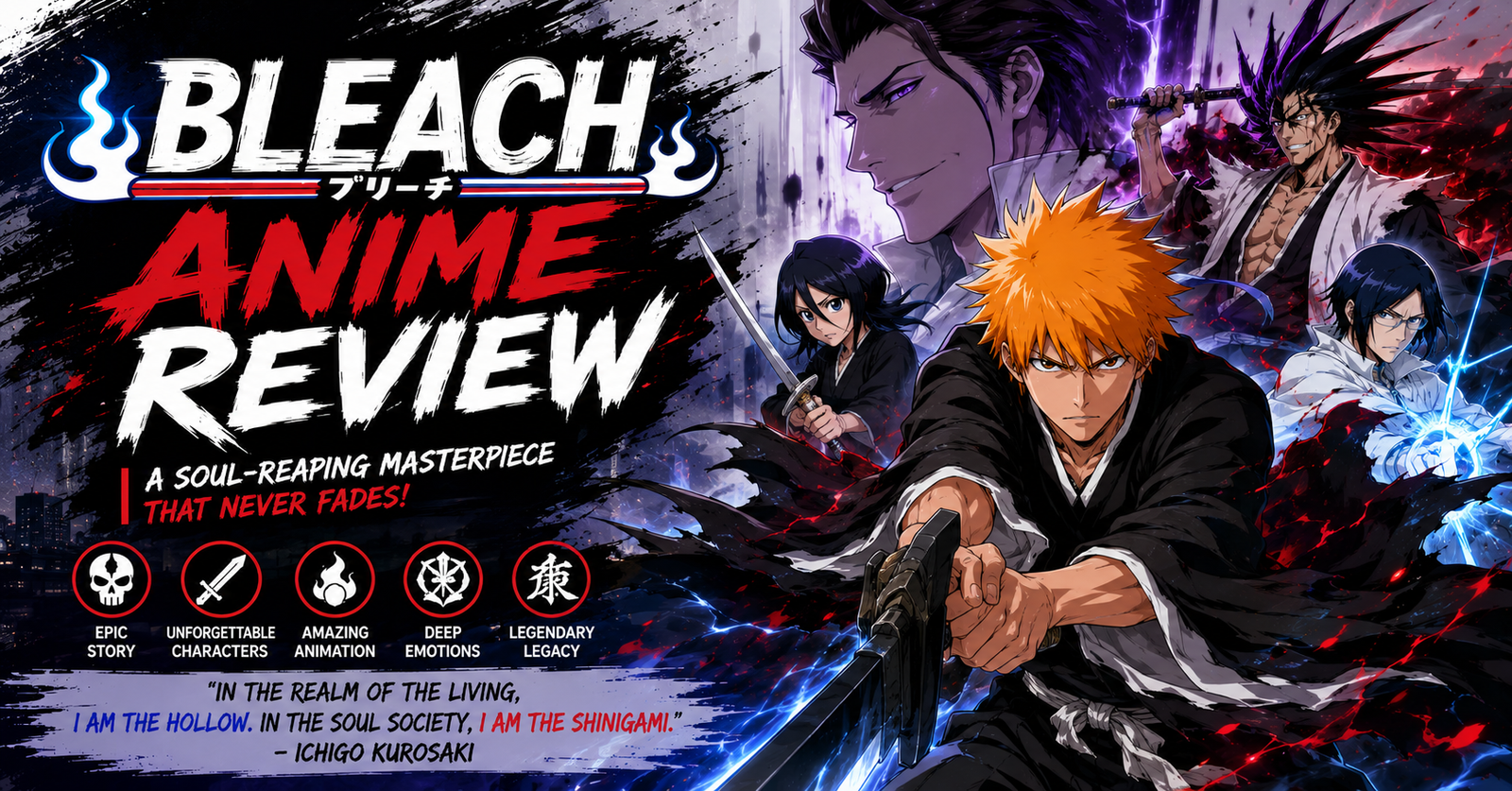

Bleach built its reputation on style as much as substance, sharp character designs, a soundtrack that still gets referenced today, and fight choreography that influenced a generation of shonen action. This review covers the story, the director and studio behind it, the voice performances, the score, and how the recent Thousand-Year Blood War continuation changed the conversation around the series’ legacy.
What Is Bleach About?
Based on Tite Kubo’s manga, Bleach follows Ichigo Kurosaki, a teenager who gains the powers of a Soul Reaper after a chance encounter with Rukia Kuchiki, a death personification tasked with guiding souls to the afterlife and purifying corrupted spirits known as Hollows. After absorbing Rukia’s powers, Ichigo is pulled into a hidden world of soul society politics, supernatural threats, and eventually a war that spans multiple dimensions. What starts as an episodic monster-of-the-week structure quickly evolves into a densely plotted story about loss, identity, and the cost of power.
Direction and Studio Behind Bleach
The anime was produced by Studio Pierrot and directed by Noriyuki Abe, who guided the series through its original 366-episode run from 2004 to 2012. Abe’s direction leaned into stylized action sequences and distinct character silhouettes that made even background characters instantly recognizable, a visual approach that became one of the show’s defining traits. When the series returned for its long-awaited final arc, Bleach: Thousand-Year Blood War, direction shifted to Tomohisa Taguchi, whose sharper, more modern animation style gave the conclusion a noticeably different visual polish while still respecting the tone Abe had established.
Voice Cast: The Soul Society Roster
Masakazu Morita has voiced Ichigo Kurosaki in Japanese since the series began, delivering a performance that balances teenage bravado with real vulnerability as the stakes escalate. Fumiko Orikasa voices Rukia, and Romi Park voices Toshiro Hitsugaya, both central to some of the show’s most memorable emotional beats. On the English dub side, Johnny Yong Bosch became closely associated with Ichigo, backed by Michelle Ruff as Rukia and Steve Staley as Hitsugaya. The consistency of both casts across the original run and into the Thousand-Year Blood War revival gave longtime fans a genuine sense of continuity, despite a decade-long gap between the story’s pause and its eventual conclusion.
The Score That Defined a Generation
Composer Shiro Sagisu, also known for his work on Neon Genesis Evangelion, scored Bleach with a soundtrack that leaned into rock, orchestral, and jazz influences depending on the scene. Sagisu’s music became so iconic that individual tracks are still widely recognized outside the context of the show itself, often resurfacing in internet culture years after their original use. For Thousand-Year Blood War, Sagisu returned to compose new material while reworking classic themes, giving longtime fans a sense of familiarity while still marking the arc as something new.
Story Pacing and the Filler Problem
Like many long-running shonen adaptations, Bleach dealt with significant filler content, particularly during stretches where the anime caught up to or outpaced the source manga. This is consistently the most common criticism across reviews of the original run, and it’s a fair one, certain arcs drag in ways that test viewer patience. That said, the manga-adapted material, especially the Soul Society arc and the eventual Thousand-Year Blood War, delivers some of the tightest, best-paced storytelling in the genre.
Why Thousand-Year Blood War Changed Everything
For years, Bleach’s anime ended on an unresolved note, with its final story arc left unadapted. The 2022 revival with Thousand-Year Blood War corrected that, adapting the manga’s climactic final arc with noticeably improved animation and pacing compared to the original run. It’s widely regarded as a significant step up in production quality, giving the series the conclusion longtime fans had been waiting over a decade to see.
Is Bleach Worth Watching Today?
Yes, particularly now that the story has a proper ending. New viewers can expect a strong opening arc, a rockier middle stretch with filler-driven pacing issues, and a genuinely excellent conclusion in Thousand-Year Blood War. It’s a series where patience through the slower stretches pays off significantly by the finale.
Frequently Asked Questions
Who composed the Bleach soundtrack?
Shiro Sagisu composed the score for both the original series and Thousand-Year Blood War, blending rock, orchestral, and jazz influences throughout.
Who directed the original Bleach anime?
Noriyuki Abe directed the original 366-episode run, with Tomohisa Taguchi taking over direction for Thousand-Year Blood War.
Is Bleach worth watching despite the filler episodes?
Yes. While certain stretches lean heavily on filler, the manga-adapted arcs, especially the finale, are consistently considered some of the strongest in the genre.
Who voices Ichigo Kurosaki in the English dub?
Johnny Yong Bosch voices Ichigo in the English dub, while Masakazu Morita performs the role in Japanese.
Do I need to watch the original series before Thousand-Year Blood War?
Yes. Thousand-Year Blood War is a direct continuation of the original story and assumes familiarity with characters and events from earlier arcs.
HiAnimes.us is a free source for your day-to-day anime reviews and a trusted guide for safe streaming. Whether you’re revisiting Bleach for its finale or starting from the beginning, we’re here to help you make informed viewing choices.



Leave a Reply