
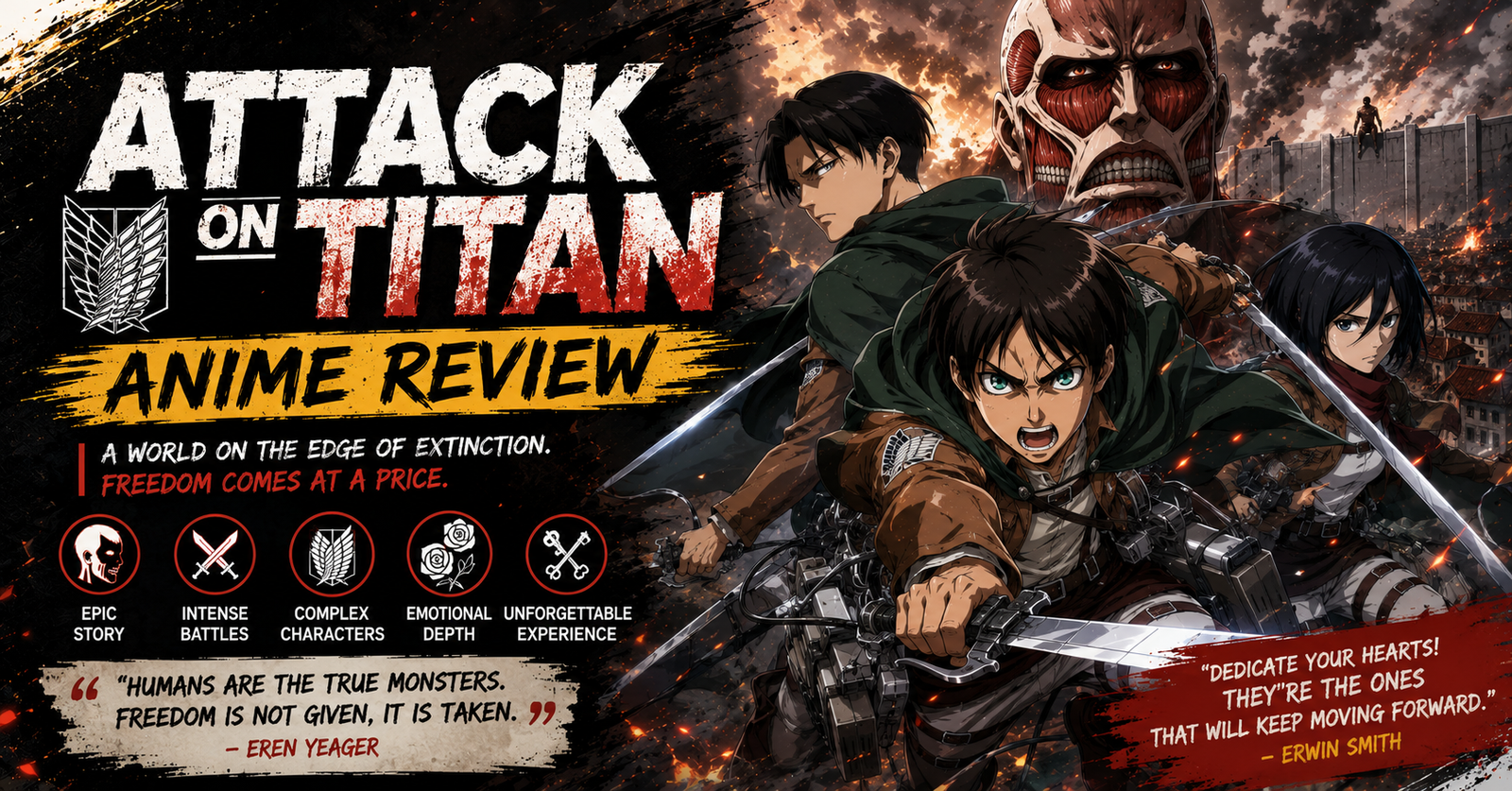

Few anime series have shifted the conversation around the medium quite like Attack on Titan. What began as a brutal, claustrophobic survival story about humanity trapped behind walls evolved into one of the most ambitious political and philosophical narratives in modern anime. This review covers the story, the direction and studios behind it, the voice cast, the score, and why the series still holds up as a genre-defining work.
What Is Attack on Titan About?
Based on Hajime Isayama’s manga, the story begins in a world where humanity lives inside massive walled cities to protect itself from Titans, giant humanoid creatures that devour people seemingly without reason. After his hometown is destroyed and his mother killed in a Titan attack, Eren Yeager joins the military determined to eliminate every Titan in existence. What starts as a straightforward revenge premise gradually unravels into something far more complex, revealing hidden histories, political conspiracies, and moral gray areas that force both Eren and the audience to question who the real enemy actually is.
Direction and Studio Work Across the Series
The original seasons were directed by Tetsuro Araki, known for his earlier work on Death Note, with animation produced by Wit Studio. Araki’s direction leaned into relentless pacing and visceral action, particularly during the Titan-clearing sequences that defined the show’s early identity. For the fourth and final season, production shifted to MAPPA, with direction handled by Yuichiro Hayashi and Jun Shishido. This transition brought a noticeably darker visual tone and more grounded, war-driven cinematography suited to the story’s shift from monster-focused horror to full-scale geopolitical conflict.
Voice Cast: Carrying the Weight of a Decade-Long Story
Yuki Kaji voices Eren Yeager in Japanese, delivering a performance that tracks the character’s transformation from an impulsive teenager into a much darker, morally ambiguous figure by the series’ end. Yui Ishikawa voices Mikasa Ackerman and Marina Inoue voices Armin Arlert, both anchoring the emotional core of the story through its most devastating turns. On the English dub side, the cast has remained largely consistent across the franchise’s run, giving longtime viewers a sense of continuity even as the story’s tone shifts dramatically between seasons. The consistency of both casts across nearly a decade of production is part of why the finale lands as hard as it does.
The Score That Defined the Show’s Identity
Composer Hiroyuki Sawano scored the first three seasons, crafting a soundtrack built around operatic vocals, heavy percussion, and orchestral swells that became instantly recognizable well beyond the anime community. Tracks composed for major battle sequences have taken on a life of their own online, frequently used as reference points for dramatic tension in unrelated content. For the fourth season, Kohta Yamamoto joined Sawano as co-composer, contributing new material suited to the story’s shift toward a more somber, war-torn tone while preserving the musical identity established in earlier seasons.
Story Structure and Thematic Depth
What separates Attack on Titan from many action-driven series is its willingness to complicate its own premise. Characters introduced as villains are later given context that makes their actions understandable, if not forgivable, and the story’s central conflict evolves from a simple survival narrative into a meditation on cycles of violence and inherited hatred. This thematic ambition is a major reason the series is frequently cited in discussions about anime’s capacity for serious, morally complex storytelling.
Is Attack on Titan Worth Watching?
Yes, without much hesitation. The series maintains an unusually high level of consistency across its run, a rarity for long-form anime adaptations, and its willingness to escalate stakes and moral complexity rather than settle into a predictable formula keeps it compelling from the first episode through its controversial but thematically consistent finale. It’s a series best watched with patience for its darker turns, since the story only gets heavier as it progresses.
Frequently Asked Questions
Who directed Attack on Titan?
Tetsuro Araki directed the original seasons at Wit Studio, with Yuichiro Hayashi and Jun Shishido directing the final season after production moved to MAPPA.
Who composed the Attack on Titan soundtrack?
Hiroyuki Sawano composed the first three seasons, with Kohta Yamamoto joining as co-composer for the fourth and final season.
Do I need to watch Attack on Titan in order?
Yes. The story builds heavily on earlier reveals and character relationships, so watching the seasons in order is essential to understanding later arcs.
Who voices Eren Yeager in the Japanese version?
Yuki Kaji voices Eren Yeager throughout the series, tracking his transformation across nearly a decade of story development.
Why did the animation studio change for the final season?
Production shifted from Wit Studio to MAPPA for the fourth season, resulting in a notably different visual style suited to the story’s darker, more grounded tone.
HiAnimes.us is a free source for your day-to-day anime reviews and a trusted guide for safe streaming. Whether you’re revisiting the series or starting from episode one, we’re here to help you make informed viewing choices.



Leave a Reply