
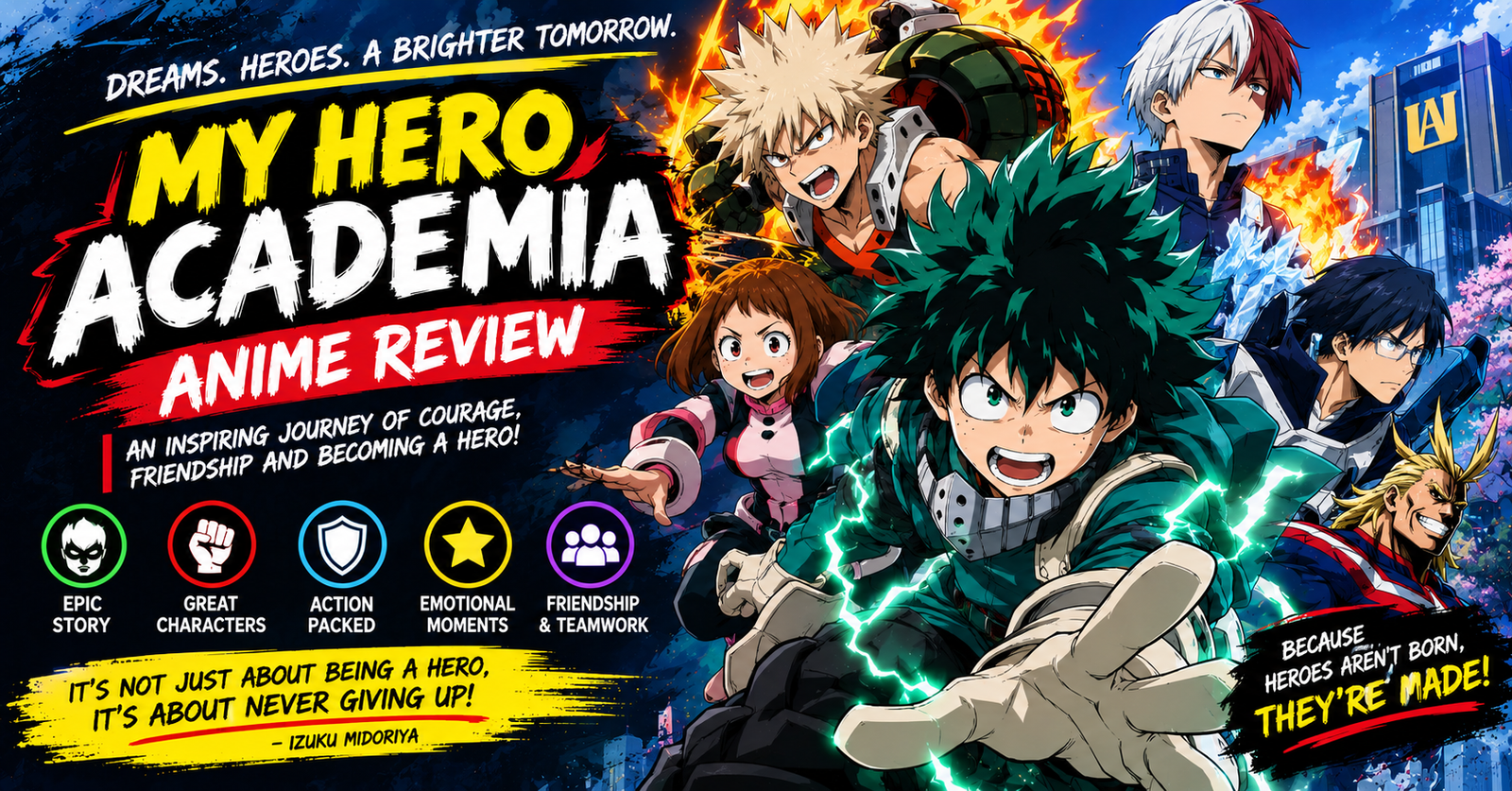

My Hero Academia arrived at a moment when the shonen genre needed a fresh hook, and it delivered one by taking the superhero premise and filtering it through the structure of a coming-of-age school story. This review covers the story, the direction and studio behind it, the voice performances, the score, and why it’s held up as one of the more consistent modern entries in the genre.
What Is My Hero Academia About?
Based on Kohei Horikoshi’s manga, the series is set in a world where roughly eighty percent of the population has developed superpowers known as Quirks. Izuku Midoriya is part of the unlucky minority born without one, yet he dreams of becoming a hero like his idol, All Might. After a chance encounter reveals his potential, Izuku inherits All Might’s own power and enrolls at U.A. High School, a prestigious academy training the next generation of professional heroes. The show balances lighthearted school-life storytelling with increasingly high-stakes battles against villains who challenge the very idea of what makes someone a hero in the first place.
Direction and Studio Behind the Series
The series has been produced by Studio Bones throughout its run, with Kenji Nagasaki directing the earliest seasons before transitioning to chief director starting with Season 4, a common structural move for long-running productions. Masahiro Mukai took over as director for several subsequent seasons, with later direction handled by other members of the production team as the show moved through its later arcs. Nagasaki’s early direction established a visual language that balanced expressive, almost comedic character animation with genuinely tense, high-impact fight choreography, a tonal blend the series has maintained even as directorial responsibilities shifted over time.
Voice Cast: Bringing U.A. High School to Life
Daiki Yamashita voices Izuku Midoriya in Japanese, delivering a performance that captures both the character’s nervous energy early on and his growing confidence as the story progresses. Nobuhiko Okamoto voices Katsuki Bakugo, Izuku’s rival-turned-ally, with a sharp, aggressive edge that softens in believable ways as the character develops. Ayane Sakura voices Ochaco Uraraka, and Kenta Miyake gives All Might a booming, larger-than-life delivery that contrasts effectively with the character’s more vulnerable moments. The English dub has kept a consistent core cast across the show’s entire run, which has helped the series build a strong following among viewers who prefer dubbed content.
The Score That Powers the Action
Composer Yuki Hayashi has scored the series since its first season, crafting a soundtrack that leans into orchestral bombast during major fight sequences while still finding quieter, more sentimental cues for the show’s frequent emotional beats. Hayashi’s work draws favorable comparisons to composers known for large-scale action scoring, and tracks used during pivotal confrontations, particularly those involving All Might, have become fan favorites well beyond the show’s immediate audience. The consistency of having one composer across the entire main series has given the show a unified musical identity that’s rare for productions this long.
Story Structure and Character Growth
What sets My Hero Academia apart from other school-based shonen series is its willingness to treat its supporting cast as fully realized characters rather than background noise. Side students at U.A. get dedicated arcs exploring their own motivations and growth, and several major villains are given enough backstory to complicate simple good-versus-evil framing. The pacing does slow in certain stretches, particularly during some of the more dialogue-heavy training arcs, but the payoff during major tournament and rescue arcs consistently delivers on the tension the show builds.
Is My Hero Academia Worth Watching?
Yes, particularly for viewers looking for a modern entry point into shonen anime that doesn’t require the kind of decades-long time commitment some older franchises demand. The show balances humor, action, and genuine emotional stakes effectively, and its central theme, that heroism is a choice rather than an inherent trait, gives the story a consistent emotional throughline across its many arcs and companion films.
Frequently Asked Questions
Who directed My Hero Academia?
Kenji Nagasaki directed the earliest seasons before becoming chief director starting with Season 4, with Masahiro Mukai and other directors handling later seasons.
Who composed the My Hero Academia soundtrack?
Yuki Hayashi has composed the score for the entire series, blending orchestral action cues with quieter emotional themes.
Do I need to watch the movies to understand the main story?
No, the films are largely self-contained side stories, though they feature the same voice cast and take place within the same continuity as the main series.
Who voices Izuku Midoriya in the English dub?
The English dub has maintained a consistent core cast throughout the series’ run, while Daiki Yamashita voices the character in Japanese.
Is My Hero Academia appropriate for younger viewers?
The series contains action violence typical of the shonen genre, and it’s worth checking the specific rating and content guidance for your intended audience before watching.



Leave a Reply